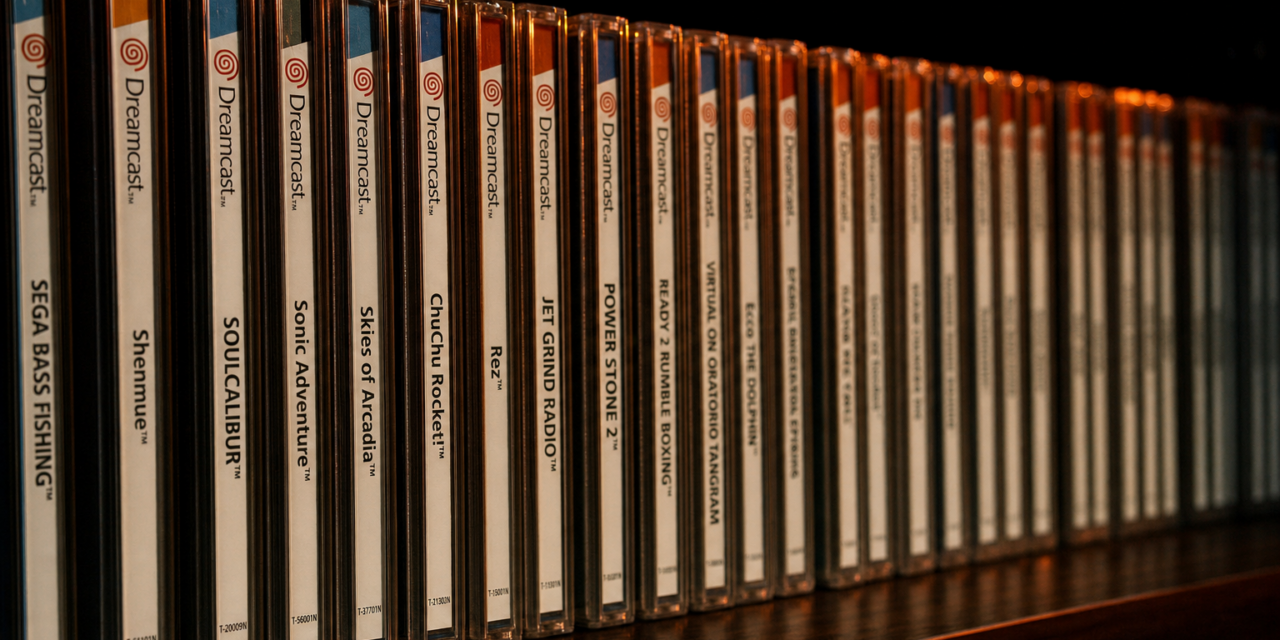
When Sega discontinued the Dreamcast in March 2001, it ended the console’s commercial lifecycle but not its active development. A small community of independent studios, publishers, and hardware enthusiasts continued to produce physically manufactured Dreamcast games for more than a decade after the platform’s official end-of-life. These titles — developed without Sega involvement, manufactured on GD-ROM media, and sold through specialist storefronts and at retro gaming events — form a distinct and historically underrepresented chapter in the console’s history.
This page documents the post-commercial Dreamcast game catalogue with particular focus on titles from the RedSpot Games, NG:Dev.Team, and Hucast publishing catalogues — the studios and labels responsible for the majority of physically manufactured indie releases between 2007 and 2017.
The Post-Commercial Dreamcast Scene: An Overview
The Dreamcast’s continued viability for physical indie development after 2001 rested on several technical and market factors. The GD-ROM format, while a proprietary high-density medium, was well-understood by third-party manufacturers willing to produce small-batch runs. The hardware — SH-4 CPU and PowerVR CLX2 GPU — was well-documented by the open-source development community, with toolchains available outside Sega’s official SDK. And critically, the Dreamcast retained a dedicated enthusiast community that had demonstrated willingness to pay collector prices for physical media.
The first organised post-commercial publisher was NG:Dev.Team, a German studio founded by the Müller brothers that released Last Hope in 2007 as a vertical shoot-em-up explicitly targeting Dreamcast collectors. Last Hope’s commercial success — it sold out its initial production run and triggered a second pressing — established the small-batch physical Dreamcast market as a viable commercial niche. RedSpot Games, also German, followed as a publisher rather than developer, licensing completed titles from independent studios and handling manufacturing and distribution. Hucast Games, founded by René Hellwig (a former NG:Dev.Team member), became another developer-publisher in the same space around 2010.
The catalogue that emerged from this ecosystem spans roughly 30 physically manufactured titles released between 2007 and 2017, concentrated primarily in shoot-em-ups but including puzzle games, racers, and platformers. Several titles received multiple editions or variants, and some were also released on other platforms concurrently or subsequently.
RedSpot Games Catalogue
RedSpot Games was the publisher most associated with the physical Dreamcast revival market during its peak years. The label, operated from Germany, handled manufacturing and distribution for externally developed titles rather than maintaining an in-house development team. The catalogue includes:
- Sturmwind (2012/2013) — Horizontal shoot-em-up by Duranik. 16 levels, dual flight modes, Limited and Standard editions. The most technically complex RedSpot title and the highest-value item in the collector market.
- Rush Rush Rally Racing (2009) / Rush Rush Rally Reloaded (2013) — Top-down arcade racer by Senile Team. Online leaderboards via community infrastructure. The Reloaded edition later released on Steam.
- Wind and Water: Puzzle Battles (2009) — Falling-block puzzle game by Yuan Works, ported from GP2X with expanded content. The most genre-diverse title in the RedSpot catalogue.
- DUX (2009) — Horizontal shoot-em-up by Hucast. Often cited alongside Sturmwind as the strongest entry in the RedSpot line. A 1.5 update and a collector’s edition were produced in subsequent years.
- Fast Striker (2010) — Vertical shoot-em-up by NG:Dev.Team, co-published with RedSpot. Standard and Limited editions produced; the Limited Edition is among the rarest in the post-commercial catalogue.
NG:Dev.Team Catalogue
NG:Dev.Team, founded by Timm and René Müller in Germany, is the oldest continuous developer in the post-commercial Dreamcast space and the studio that effectively established the commercial niche with Last Hope in 2007. Their catalogue is shoot-em-up focused and technically conservative compared to Duranik’s approach with Sturmwind, but it demonstrates consistent quality over the longest production run in the indie Dreamcast market:
- Last Hope (2007) — Horizontal shoot-em-up, the title that initiated the commercial indie Dreamcast revival. First and second pressings sold out; a “Pink Bullets” edition with revised difficulty was released in 2010.
- Fast Striker (2010) — Vertical shoot-em-up. The NG:Dev.Team edition was produced in parallel with the RedSpot Games co-publishing arrangement.
- Neo XYX (2013) — Vertical shoot-em-up with a Neo Geo-influenced aesthetic. Limited and Standard editions; widely considered the technical peak of NG:Dev.Team’s Dreamcast work.
- GunLord (2012) — A run-and-gun/platform game modelled on Turrican, developed in collaboration with Factor 5’s alumni community. The most genre-divergent NG:Dev.Team release and among the most expensive in the secondary market.
Hucast Games Catalogue
Hucast Games was founded by René Hellwig, formerly of NG:Dev.Team, and operates as both developer and publisher. The catalogue focuses exclusively on shoot-em-ups:
- DUX (2009) — Originally published by RedSpot Games, later reissued by Hucast in multiple editions including a DUX 1.5 update and a collector’s package.
- Redux: Dark Matters (2014) — Vertical shoot-em-up and the most recent Hucast Dreamcast release. Standard and Limited editions; the title generated significant pre-release interest in the collector community and sold out quickly.
- Ghost Blade (2015) — Vertical shoot-em-up co-developed with Picorinne Soft. Available in Standard and Limited editions; the Limited Edition includes a music CD and art book.
Dreamcast Hardware and the Indie Development Environment
The technical infrastructure for post-commercial Dreamcast development evolved over the platform’s homebrew years. The primary open-source toolchain, KallistiOS, provided a C/C++ programming environment targeting the SH-4 CPU without requiring Sega’s official SDK. KallistiOS handles hardware initialisation, GD-ROM access, controller input, audio via the AICA chip, and the PowerVR rendering pipeline through a documented API that accumulated contributions from the community over more than a decade.
GD-ROM manufacturing for small batches was available from specialist optical media manufacturers in Germany and Japan who could produce runs as small as 200 units. The economics were not favourable at that scale — per-unit manufacturing cost was high relative to retail price — but the market’s willingness to pay $30–$60 for physical releases made the numbers work for studios with modest development budgets and no marketing overhead.
The Dreamcast’s DreamKey browser and built-in modem support allowed games to implement online functionality through community-hosted servers without Sega’s infrastructure. Rush Rush Rally Racing’s time-trial leaderboards and some early homebrew titles demonstrated this possibility; the community BBA (broadband adapter) compatibility project maintained server infrastructure that active Dreamcast online features could connect to through the 2010s.
Collecting Post-Commercial Dreamcast Games
The secondary market for post-commercial Dreamcast physical releases is active and reasonably well-documented. Prices vary significantly by title and edition, but the general pattern is: Limited Editions of shoot-em-ups from NG:Dev.Team and Hucast command the highest prices ($100–$300+ for sealed copies of titles like Neo XYX Limited and Redux Limited), followed by the Sturmwind Limited Edition ($90–$140), with standard editions of most titles trading in the $25–$70 range.
Key considerations for buyers entering this market:
- GD-ROM fragility: The jewel-case format used for all these releases is brittle. Cracks in the case reduce value significantly. Buyers should request condition photographs specifically of the case spine and hinge points.
- Edition verification: Several titles (Sturmwind, Fast Striker, Last Hope, DUX) have multiple editions with different contents and values. Sellers should specify which edition is being sold; buyers should verify against known edition documentation before purchasing at Limited Edition prices.
- Manual completeness: Most Dreamcast indie titles include a printed manual. Complete-in-box prices assume manual presence. Disc-only prices are meaningfully lower and should reflect the missing component.
- Regional variants: Some titles were produced in regional editions with different packaging. NG:Dev.Team in particular produced both European and North American editions of several titles with different box artwork.
Where to Find Post-Commercial Dreamcast Games
Active storefronts specialising in physical retro media are the primary source for in-demand titles. Storefronts that maintain dedicated Dreamcast indie sections (as opposed to general retro game dealers who may not distinguish between official Sega releases and post-commercial titles) tend to have better condition documentation and more accurate edition identification.
Auction platforms see regular listings of individual titles, particularly in the $25–$60 range. Higher-value items (Sturmwind Limited Edition, NG:Dev.Team limited editions) appear less frequently and tend to attract competitive bidding. Japanese import storefronts occasionally carry titles that were initially distributed primarily in Europe, sometimes at different price points than European or North American sellers.
The Dreamcast-Talk and Dreamcast-Scene community forums maintain sale and trade sections where collector-to-collector transactions occur at prices closer to the actual collector community consensus than auction platform results, which can skew in either direction based on timing and buyer pool.
Conclusion: The Legacy of Indie Dreamcast Development
The post-commercial Dreamcast catalogue demonstrates something unusual in video game history: a dedicated developer and collector community sustaining physical hardware production for more than 15 years after a console’s commercial end-of-life, producing technically accomplished titles that in some cases exceeded the quality of the official library. This happened because of specific conditions — a passionate community, an open-source toolchain, accessible manufacturing options, and a collector market willing to pay prices that made small-batch economics viable — that are unlikely to recur in the same form for any modern platform.
The result is a body of approximately 30 physically manufactured titles that now constitute their own collector category, distinct from the official Dreamcast library and from the homebrew freeware scene that preceded and paralleled the commercial indie releases. For collectors and Dreamcast enthusiasts, it represents a genuinely distinct chapter in the platform’s history.