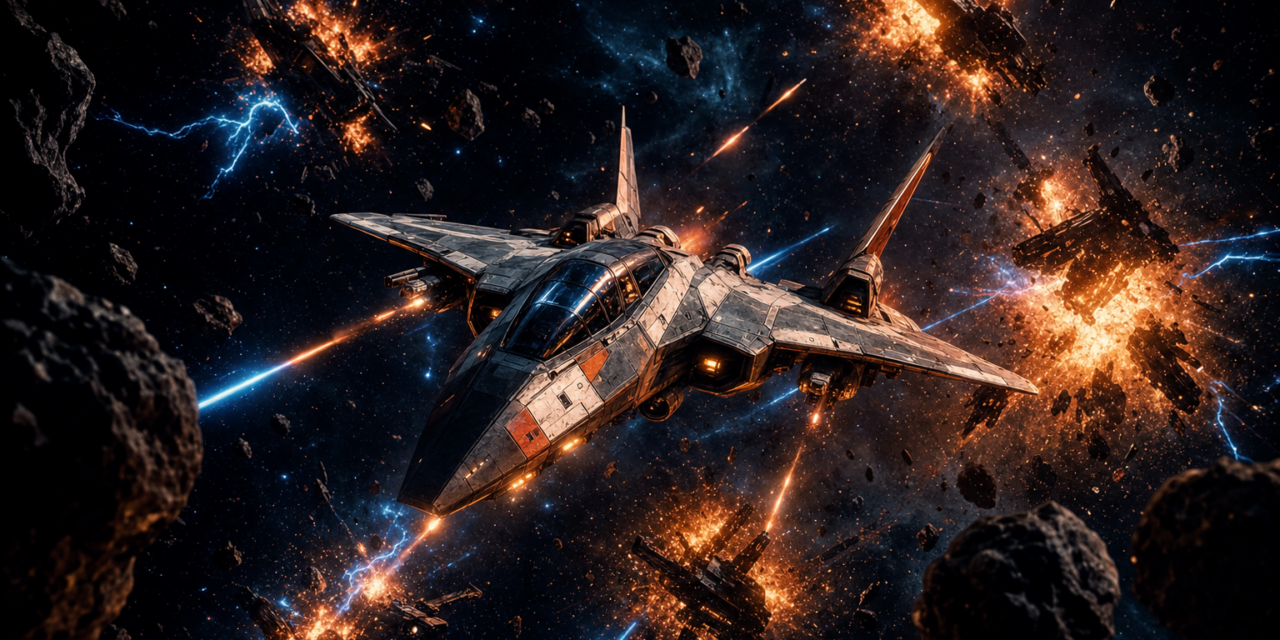
Sturmwind is a scrolling shoot-em-up developed by the German studio Duranik and published for the Sega Dreamcast in 2012 and 2013. It stands as one of the most technically sophisticated titles ever produced for the hardware, released more than a decade after Sega’s console went end-of-life. Physical manufacturing was handled by RedSpot Games and later RapidEye Moves, with production runs small enough that sealed copies now regularly trade above $80 on the secondary market.
The game’s name translates roughly as “storm wind” in German, and it fits: Sturmwind is relentless from the first screen. Sixteen levels across eight stages, two distinct flight modes, a fully licensed CD-Audio soundtrack, and enemy counts that push the SH-4 CPU harder than almost anything Sega’s own studios attempted. For Dreamcast collectors and shoot-em-up enthusiasts, it occupies a category of its own.
What Is Sturmwind? Background and Development
Duranik, the Leipzig-based studio behind Sturmwind, began work on the game around 2008. The project was announced publicly at a Dreamcast community event in 2010 under the working title “Sturmwind: Windstärke 12,” and the reception was strong enough that RedSpot Games — then the leading European publisher of physical Dreamcast releases — agreed to handle manufacturing and distribution.
Development stretched across four years, driven largely by the ambition of the core engine. Duranik built a custom renderer for the PowerVR CLX2 GPU that exploits a set of hardware features Sega’s official toolchain treated as an afterthought: modifier volumes for per-object shadow casting, stencil-shadow techniques for enemies, and a particle compositor capable of generating hundreds of simultaneous sprites without dropping below 60 fps. The result is a game that looks better than most official Dreamcast releases from 2001, despite being built on open-source toolchains with no Sega licence.
The original Dreamcast release shipped in two editions in 2012 for European buyers, with a wider North American distribution following in 2013 after RapidEye Moves took over publishing duties from RedSpot Games. A Nintendo Switch port developed by Duranik arrived in 2022, expanding the game’s reach to modern hardware for the first time.
Gameplay and Mechanics
Sturmwind’s core loop is a horizontal scrolling shooter in the tradition of R-Type and Gradius, but with two structural departures from genre convention. The first is the dual-mode flight system: players can switch between Classic mode — a fixed-width play field where the player ship stays centered — and Forward mode, where the ship advances through the level at variable speed and the player steers into a continuously scrolling environment. Both modes are available for every level, and the mode choice influences scoring multipliers and available power-up positions.
The second departure is the weapon selection screen between stages. Rather than accumulating power-ups through the run, Sturmwind gives players three weapon loadout slots before each level begins. Twelve weapons span categories from spread shot and homing missile to a reflective laser that bounces off certain surfaces. Mastering which loadout suits each stage’s enemy formations is a significant part of the game’s depth — casual players can progress on Normal with whatever fires fastest, but score-chasers need to study the enemy patterns of every screen.
Difficulty is stepped across four settings: Easy, Normal, Hard, and Arcade. Arcade mode removes continues and requires a single-credit clear; it is genuinely demanding and represents dozens of hours of investment for a clean run. Normal mode is approachable for players with some shoot-em-up background, with a generous credit allowance and checkpoints at the midpoint of each stage.
Level design covers eight thematic environments — oceanic platforms, volcanic underground, orbital station, and others — each split into two sub-levels with a boss encounter. Bosses are the high point: large multi-segment enemies that expose weak points in specific phases, and whose attack patterns shift when pushed below half health. The final boss is a 10-minute encounter that cycles through three full phases and demands mastery of both flight modes.
Graphics and Technical Achievement
On original Dreamcast hardware, Sturmwind runs at a locked 60 frames per second at 640×480. The visual density is remarkable: enemy sprite counts in later stages routinely exceed 60 simultaneous objects, bullet clouds can fill a third of the screen during boss phases, and background parallax layers stack to seven or eight planes of depth without the kind of pop-in that plagued officially licensed titles with fewer simultaneous elements.
The sprite work is drawn in a hybrid style — backgrounds rendered in 3D geometry, player ship and enemies in high-resolution 2D sprites scaled and rotated via the PowerVR hardware. The player ship model has 32 frames of animation for the banking roll, more than most Naomi arcade titles managed. Explosions chain into particle cascades that linger on-screen for three to four seconds without affecting the frame rate, a party trick that Duranik cites as a primary engineering goal from the project’s first technical document.
The soundtrack consists of 16 tracks composed by Cyke (a German electronic artist), licensed on a per-stage basis. Audio playback is handled via CD-Audio rather than the Dreamcast’s AICA chip, which means the game occupies most of the disc’s audio capacity with lossless stereo tracks rather than MIDI sequences. The result is a soundtrack that holds up independently of the game — it has been released as a standalone MP3 download and has a small collector market of its own.
Sturmwind Limited Edition vs Standard Edition
Sturmwind was produced in two physical editions, each manufactured in quantities small enough to make either a legitimate collector’s item today.
The Limited Edition was the first to market, published by RedSpot Games in 2012 for European distribution. The package includes: the game disc in a standard Dreamcast GD-ROM jewel case; a VMU minigame card (a standalone VMU file that can be transferred to the Dreamcast’s memory unit and played independently of the main game); a holographic foil sticker for the VMU; a printed postcard; and a numbered certificate of authenticity. Print run figures were not publicly disclosed by RedSpot Games, but community estimates from sealed-copy tracking suggest fewer than 2,000 units were produced. Sealed Limited Edition copies consistently trade between $90 and $140 depending on condition, with top-condition examples occasionally exceeding $160.
The Standard Edition was released in 2013 with North American distribution handled by RapidEye Moves. The packaging is simpler — game disc plus manual — without the extras of the Limited Edition. The print run for the Standard Edition was somewhat larger, and loose copies trade between $40 and $70 in played condition. Complete-in-box Standard Edition copies overlap significantly with Limited Edition pricing at the high end.
A key functional difference: both editions contain the identical game. There are no exclusive levels, bonus stages, or gameplay content tied to the Limited Edition. The difference is entirely in the physical extras and manufacturing certificate. For players who intend to play the game rather than keep it sealed, the Standard Edition is the rational purchase. For collectors building a complete RedSpot Games library, the Limited Edition is the target.
Sturmwind Dreamcast vs Switch
Duranik released a Nintendo Switch port of Sturmwind in 2022, built on a new engine and sold via the Nintendo eShop. The Switch version has been well-received, but the two releases are meaningfully different experiences rather than interchangeable alternatives.
The Dreamcast version’s visual character comes partly from the hardware it runs on: the PowerVR CLX2’s tile-based deferred rendering produces a particular kind of edge aliasing and transparency blending that software emulation cannot fully replicate, and which the Switch’s PowerVR descendant (NVN) handles differently by default. The CRT phosphor characteristic of the original display also shapes how the game looks in ways that no software filter fully captures. Players who grew up with the original hardware will notice these differences immediately; players coming to the game fresh on Switch may not register them at all.
Functionally, the Switch port adds: a widescreen 16:9 display option (the original Dreamcast release was 4:3 only), higher-resolution assets for the player ship and some enemies, remastered soundtrack, and a local multiplayer mode that was not present in the original release. The score attack leaderboards on Switch are also more active than any community-run Dreamcast equivalent, which benefits competitive players.
For most people discovering Sturmwind in 2025 or later, the Switch version is the practical starting point — it is readily available, inexpensive, and runs without requiring specific hardware. The Dreamcast version remains the historically significant artifact and the preferred format for purists, collectors, and anyone who wants the original soundtrack as Duranik intended it to be heard through the console’s hardware DAC.
Development History: Duranik and RedSpot Games
Understanding Sturmwind requires some context about the commercial structure behind it. Duranik is a small German development studio that has operated primarily in the game-jam and indie space. The studio’s founders were active in the Dreamcast homebrew community from the early 2000s, and Sturmwind was their first major commercial release. The game was conceived as a showcase of what the Dreamcast could do when developers weren’t constrained by the feature-set priorities of Sega’s internal toolchain — priorities that had always favoured 3D polygon throughput over the 2D sprite compositing that the PowerVR architecture could handle with unusual efficiency.
RedSpot Games, founded by André Bächstädt in Germany around 2007, was the European publisher of record for the first three years of Sturmwind’s commercial life. The label’s catalogue at the time included DUX (a horizontal shooter developed by Hucast), Last Hope (a much earlier shooter from NG:Dev.Team), and Fast Striker (also from NG:Dev.Team). Sturmwind was the largest and most technically ambitious title RedSpot had committed to, and the production timeline overran estimates significantly — the 2010 announcement suggested a 2011 release, which slipped to early 2012 before the final European Limited Edition shipped in late 2012.
The transition of North American publishing duties to RapidEye Moves in 2013 allowed a larger production run for the Standard Edition, but also marked the end of RedSpot Games’ direct involvement with the title. RedSpot continued to operate until approximately 2014, at which point the label wound down without further releases. The announcement of Windstärke 12 — a follow-up or expansion — appeared in 2014 before the label’s closure effectively ended the project before it reached production.
Collecting Sturmwind: Rarity, Variants, and Market Value
Sturmwind occupies a specific tier in the Dreamcast collector market: expensive enough that it prices out casual buyers, but not so rare that it disappears from sale for months at a time. The Limited Edition is the piece collectors most actively seek, and the market for it has been remarkably stable over the past five years — prices have appreciated modestly rather than spiking on single sales, which suggests genuine collector demand rather than speculative flipping.
Several factors contribute to the game’s collector value. The Dreamcast’s GD-ROM format cannot be easily replicated on burned CDs (GD-ROMs are a proprietary Sega format storing data across three physical tracks on a high-density disc), which eliminates the casual piracy route that depresses value for many retro titles available in ISO form. Physical Dreamcast releases from the post-commercial era are also inherently limited by the economics of small-batch manufacturing: a Limited Edition run of under 2,000 units at a price point of $40–60 at launch means that the entire production volume was small enough for secondary-market pressure to establish quickly.
Condition matters significantly: jewel cases for the Dreamcast era are notoriously fragile, and Limited Edition copies with intact cases, complete inserts, the VMU card, the holographic sticker, and the numbered certificate in clean condition are meaningfully rarer than the raw production number implies. Buyers should verify the presence of all included items — sellers sometimes strip the extras before listing the disc alone.
Where to Play Sturmwind Today
For players who want the original Dreamcast experience, the secondary market is the only route. Storefronts specialising in retro physical media — particularly those with active Japanese import inventory — list copies regularly. Auction platforms see regular listings at the price ranges described above. Condition verification photographs should be checked carefully for jewel-case cracks and insert completeness.
For players who want to experience the game without hardware investment, the Switch eShop version is the practical choice. It is priced at a standard digital release price point, runs on unmodified hardware, and represents Duranik’s current recommended version of the game. The Switch port was not available as of the original Dreamcast release window and should be understood as a distinct product rather than a direct port — same game, substantially updated presentation.
Emulation of the Dreamcast version via DEMUL or Flycast is technically possible for personal archival purposes, but neither emulator fully replicates the PowerVR CLX2’s rendering behaviour for Sturmwind specifically — the particle compositor effects in particular resolve differently under software rasterisation, and the game was developed to run on the original hardware path.
Conclusion: Is Sturmwind Worth It for Dreamcast Collectors?
Sturmwind is the strongest argument that the Dreamcast’s hardware potential was never fully realised during its commercial lifespan. Released five years after Sega discontinued support for the platform, it demonstrates what the SH-4 and PowerVR CLX2 could produce when developers had the time to understand the architecture rather than rush a title to a competitive launch window.
Whether it is worth the secondary-market price depends on context. For collectors building a complete catalogue of physically manufactured post-commercial Dreamcast titles, the Limited Edition is essential — it is a central piece of a small but historically significant body of work. For players who primarily want to play the game, the Switch port at a fraction of the physical price is the rational choice. For anyone interested in both, the two versions complement rather than substitute for each other.
As an object, the Limited Edition is handsome. As a game, Sturmwind is disciplined and technically exhilarating in the way that the best shoot-em-ups of the mid-2000s were disciplined: no padding, no concessions to casual accessibility beyond the Easy difficulty mode, and a final act that earns its difficulty.